A deep dive into the burn-and-mint equilibrium, fair launch mechanics, and economic design behind the Canton Network’s native token.
Introduction: Why Canton’s Economic Model Matters
Most Layer-1 blockchains follow a familiar playbook. Raise from VCs, allocate tokens to founders and early investors, launch with a pre-mine, then hope that usage eventually catches up with speculation. Value accrues disproportionately to those who arrived earliest, not to those who build the most.
Canton Coin ($CC) rejects that entire template.
Launched in July 2024 by Digital Asset, the Canton Network is a privacy-first, institutional-grade Layer-1 blockchain purpose-built for tokenized real-world assets (RWAs), payments, and settlements. It already supports over $6 trillion in tokenized assets and processes more than $280 billion in daily U.S. Treasury repo trades. Its backers and validators include Goldman Sachs, DTCC, Nasdaq, JPMorgan, Euroclear, and BNY Mellon, among over 600 institutions.
But what makes Canton truly different is not the institutional pedigree. It is the tokenomics.
Every single $CC in circulation has been earned by delivering verifiable utility to the network. No pre-mine. No ICO. No VC allocation. No founder reserve. Canton takes the foundational principle that tokens should only enter circulation through work, and rebuilds it for a world of institutional finance, programmable assets, and application-layer economics.
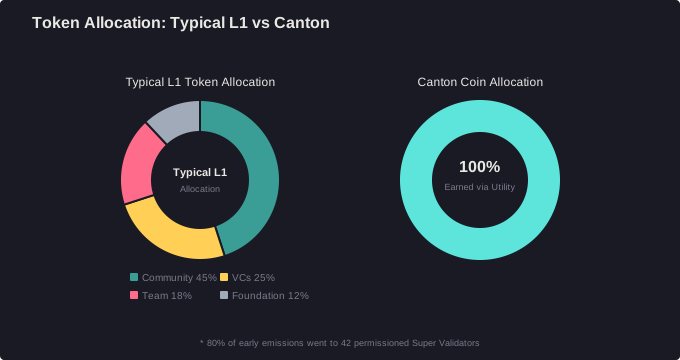
An important caveat upfront: while no tokens were pre-allocated, the early emission schedule directed 80% of rewards to just 42 Super Validators — known institutions running permissioned infrastructure. This is structurally different from Bitcoin’s permissionless mining, where anyone with a CPU could participate from day one. Canton’s “fair launch” is better understood as “no pre-mine with permissioned early distribution” rather than a direct Bitcoin analogue. We will examine this tension in detail below.
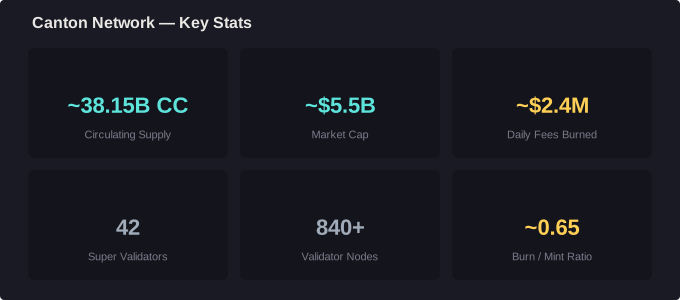
As of late March 2026, the network has roughly 38.15 billion CC in circulation, a market cap hovering around $5.5 billion, and daily fee burns of approximately $2.4 million. It is also worth noting upfront that the vast majority of Canton’s institutional activity — the $6 trillion in tokenized assets, the $280 billion in daily repo trades — runs on private synchronizers that do not touch CC at all. The token’s value proposition rests on the Global Synchronizer’s opt-in utility, not on mandatory network access. This distinction matters and we will examine it throughout.
In this article, we will break down exactly how this system works, where the design is genuinely novel, where the tensions lie, and what it means for builders, validators, and the broader DeFi landscape.
The Fair Launch: Zero Pre-Mine, Zero VC, Zero Team Allocation
Canton’s fair launch is not just marketing language. It is a structural commitment embedded in the protocol from genesis. Here is exactly what “fair launch” means in this context:
No pre-mine. Not a single CC existed before the Global Synchronizer went live. Tokens could only be minted once the fully decentralized infrastructure was operational.
No pre-sale or ICO. There was no event where tokens were sold in advance to raise capital. The development of Canton was funded through Digital Asset’s traditional equity raises (from investors like Goldman Sachs, Blackstone, IBM, Nasdaq, and Tradeweb), not through token sales.
No founder or team allocation. Digital Asset, the company that built the network, holds zero special token reserves. The Canton Foundation received no allocation either. There are no vesting schedules for insiders because there are no insider tokens.
No VC token distribution. Every venture firm that invested in Canton invested in Digital Asset’s equity, not in $CC tokens. If they want $CC, they earn it through network participation like everyone else.
This stands in sharp contrast to the vast majority of crypto projects, where 15-40% of total supply is routinely reserved for teams, advisors, and venture investors before the public ever touches a token.
The asterisk on fairness. While technically accurate — no CC was pre-allocated — the practical distribution tells a more nuanced story. In the first six months, 80% of all minted CC went to just 42 Super Validators, permissioned institutions selected by the network’s governance. By month 20, these entities have accumulated tens of billions of CC. This is not the same as Bitcoin’s permissionless mining, where any anonymous participant could earn block rewards with commodity hardware. Canton’s fair launch eliminated pre-allocation but not concentration. The resulting distribution resembles a proof-of-authority chain’s early validator rewards more than a permissionless fair launch. Whether this matters depends on your definition of “fair” — no insider got free tokens, but the earning opportunity was gated from day one.
The DRW/Cumberland Question
Canton’s “no insider allocation” claim is technically accurate but requires more context to be fully honest. The most important context is the relationship between Digital Asset — the company that built Canton — and DRW, one of the world’s largest proprietary trading firms.
The founding relationship. Digital Asset was founded in 2014 out of Cumberland Mining & Materials, a DRW subsidiary. DRW has funded the project for over 11 years through $397M+ in equity rounds, alongside co-investors including Goldman Sachs, Blackstone, IBM, Nasdaq, and Tradeweb. Cumberland, DRW’s crypto trading arm and one of the largest digital asset market makers globally, is a founding Super Validator on the Canton network — earning CC rewards since genesis in July 2024, when Super Validators received 80% of all minting rewards.
The functionally-equivalent-to-founder-allocation argument. No CC was pre-allocated to DRW, Cumberland, or Digital Asset at genesis. But the entity that funded the network’s creation for a decade was simultaneously positioned as a day-one Super Validator earning the lion’s share of early emissions. The distinction between “no pre-mine” and “no insider advantage” is real but narrow. The earning opportunity was gated from day one, and the entity best positioned to earn at genesis was the parent company of the network’s creator. That is functionally equivalent to a founder allocation — the mechanism is infrastructure rewards rather than a genesis block allocation, but the economic result is similar. Super Validators as a class are primarily early network investors and institutions with pre-existing relationships to Digital Asset. This is not incidental; the SV selection process is permissioned by design.
The Tharimmune disclosure. The most publicly documented example of Cumberland’s CC holdings flowing into institutional hands is the Tharimmune vehicle, a $540M treasury vehicle assembled in October–November 2025. Bloomberg reported that DRW and Liberty City Ventures would “contribute a significant portion of the funds in the form of Canton Coins,” giving external investors — including ARK Invest, Kraken, Polychain Capital, and Broadridge — CC exposure through DRW’s holdings. Whether similar OTC transactions occurred earlier is plausible — Cumberland is a professional market maker and that is core to its business model — but not publicly confirmed.
What honest framing looks like. “No pre-mine” is technically accurate. The more complete picture: no pre-allocation, but the earning opportunity was gated from day one, and the entity best positioned to earn from it had built and funded the network for a decade before genesis. This does not invalidate Canton’s design — the emissions were earned by running real infrastructure, not gifted. But it does mean the Bitcoin analogy requires careful qualification. Bitcoin’s miners competed on open hardware from day one and anyone could participate. Canton’s Super Validators are invite-only, and the founding SV that accumulated the largest position is the parent company of the organization that built the network. The “fair launch” label is defensible in letter but requires the asterisks this article has tried to apply throughout.
The Burn-and-Mint Equilibrium: Canton’s Core Economic Engine
At the heart of Canton’s tokenomics lies the Burn-and-Mint Equilibrium (BME), a self-regulating feedback loop that ties token supply directly to real network activity. This is not a novel concept in isolation (projects like Factom, Helium, and Akash have used variations), but Canton’s implementation is the most sophisticated version deployed at institutional scale.
How Burning Works
Every fee paid on the Canton Network is permanently destroyed. When users transfer $CC, synchronize data, settle transactions, or use applications on the Global Synchronizer, they pay fees denominated in USD. These fees are settled by burning $CC at the current on-chain conversion rate (a median price proposed by Super Validators every 10 minutes).
The burned coins are gone forever. They do not go to validators, a treasury, or a foundation. They are removed from circulation entirely.
How Minting Works
New $CC is minted every 10 minutes in discrete cycles called “rounds.” The amount available for minting follows a pre-defined supply curve. These freshly minted coins are distributed as rewards to participants based on the value they contribute to the network.
Critically, coins are not minted automatically. They are only created when participants claim them after providing measurable utility, whether that means running validator infrastructure, building applications, or operating the Global Synchronizer.
The Equilibrium
The system is designed to reach a long-term steady state — specifically after year 10, when programmatic minting drops to a constant 2.5 billion CC per year. At that point, equilibrium means burns roughly match that 2.5 billion annual mint rate.
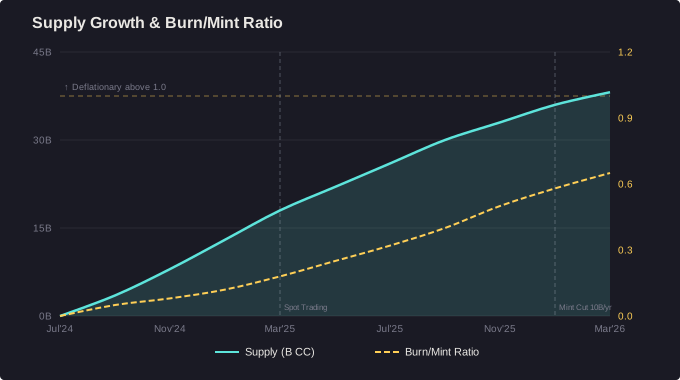
Today, the math looks different. The network is in the 1.5–5 year minting phase at 10 billion CC per year. With ~$2.4 million in daily fee burns and a CC price around $0.14–0.15, approximately 16–17 million CC are burned daily, or roughly 5.8–6.2 billion CC annualized. That gives a burn/mint ratio of approximately 0.58–0.62 (the reported ~0.65–0.70 range may reflect recent upward momentum or slightly different measurement windows). The point: current burns are well above the long-term 2.5 billion target because current minting is also well above the long-term rate. Both sides of the equation will compress as the minting curve steps down.
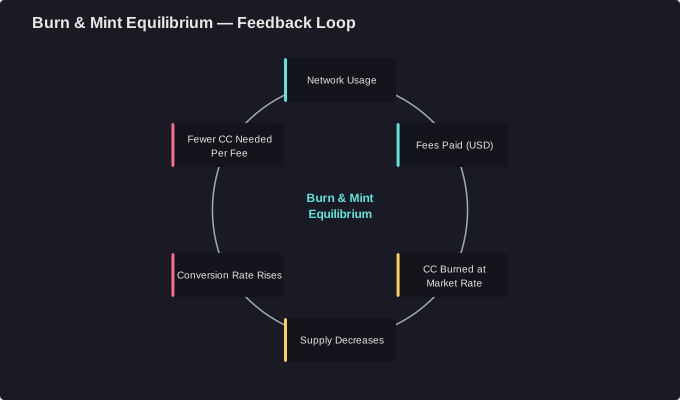
The feedback loop works like this:
When network usage increases: More fees are burned, reducing supply. Reduced supply pushes the conversion rate higher. A higher conversion rate means fewer CC need to be burned per dollar of fees. The system gradually rebalances.
When network usage decreases: Fewer fees are burned, increasing net supply. Increased supply pushes the conversion rate lower. A lower conversion rate means more CC must be burned per dollar of fees. Usage costs drop in dollar terms, potentially attracting more activity.
A critical caveat on “equilibrium.” The BME’s self-correcting logic assumes that CC market price responds mechanically to supply changes. In practice, CC trades on open markets where price is driven by speculation, liquidity, and sentiment — not just supply dynamics. The BME creates incentive structures that push toward equilibrium, but it cannot guarantee that markets will follow the script. The “gravitational pull” toward fundamental value is real but not deterministic — it operates on the same uncertain timescales as any other market-driven adjustment. Additionally, because fees are denominated in USD, the direct reflexivity between network usage and token demand is dampened. Higher usage means more CC is burned, but the dollar cost to users stays constant regardless of CC price. This is a feature for institutional adoption (predictable costs) but it weakens the direct “usage drives token value” narrative compared to chains where the token is the mandatory gas currency.
The Minting Curve: A 10-Year Programmatic Schedule
Canton’s supply is not hard-capped, but it is programmatically constrained. Over the first 10 years post-launch, a maximum of 100 billion CC can be minted. After year 10, the system transitions to a constant rate of 2.5 billion CC per year (designed to match the target burn rate at equilibrium).
The annual minting rate decreases in defined phases:
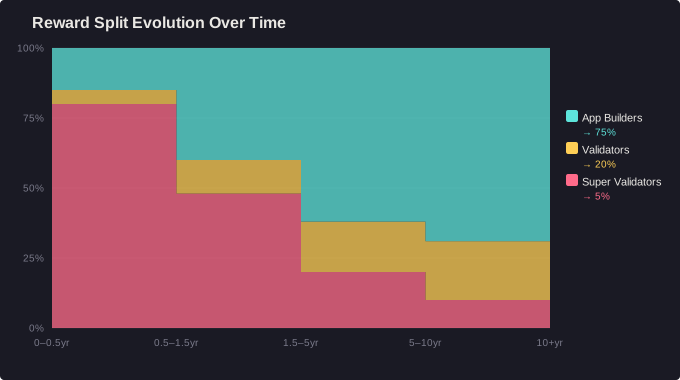
| Period | Annual Mint Rate | Period Total | App Builders % | Validators % | Super Validators % |
|---|---|---|---|---|---|
| 0 – 0.5 years | 40B | 20B | 15% | 5% | 80% |
| 0.5 – 1.5 years | 20B | 20B | 40% | 12% | 48% |
| 1.5 – 5 years | 10B | 35B | 62% | 18% | 20% |
| 5 – 10 years | 5B | 25B | 69% | 21% | 10% |
| 10-Year Total | 100B | 50B (50%) | 15B (15%) | 35B (35%) | |
| 10+ years | 2.5B/yr | 2.5B/yr | 75% | 20% | 5% |
The most important dynamic here is the deliberate shift in who gets rewarded over time. In the first six months, Super Validators received 80% of all minting rewards, a necessary incentive to bootstrap the expensive infrastructure required for a BFT consensus network. But that share drops aggressively: to 48% in year one, 20% by year two, and just 5% in steady state.
Meanwhile, Application Builders start at 15% and climb to 75% of all rewards. The protocol pays builders proportionally to the value they create — but with a significant caveat: as of September 2025, earning those rewards requires committee approval (more on this below).
A note on supply vs. the curve. The minting schedule implies up to ~40 billion CC could have been minted in the first 18 months, plus additional emissions in the current 10B/year phase. With 38.15 billion CC in circulation at month 20, there is a gap of roughly 3–4 billion CC between theoretical maximum and actual supply. This likely reflects the claim-based minting design: coins are only created when participants actively claim them after providing utility, so not every available emission is captured. The gap is modest enough to suggest near-complete uptake, but it confirms the system is not automatically minting at full capacity.
Reward Mechanics: Who Earns What, and How
Canton distributes minting rewards across three participant groups. Each group earns based on distinct, verifiable on-chain activity.
Application Builders (~50-75% of rewards, increasing over time)
This is the headline feature of Canton’s tokenomics — and the one that has evolved most significantly since launch.
The original design (pre-September 2025) had two tiers. Featured Apps, approved by Super Validators, could earn minting rewards worth up to 100x the value of fees their users burned. Unfeatured Apps could also earn rewards, capped at 80% of burned fees. Any application generating fee activity on the Global Synchronizer could earn something, making the system partially permissionless.
CIP-0078 changed this materially. Approved on September 15, 2025, CIP-0078 eliminated all CC transfer and lock fees (setting them to zero). The motivation was sound: 94.8% of CC burns came from traffic purchases, not transfer fees, and the per-transfer fees created UX friction and developer complexity. But zeroing out fees had a structural side effect — since unfeatured app rewards were calculated as a percentage of fees burned by their users’ transactions, unfeatured apps now earn zero minting rewards. The unfeatured reward pathway was not explicitly removed; it was economically nullified.
The result: app rewards are now fully permissioned. Only Featured Apps with an approved FeaturedAppRight contract earn minting rewards. Featured App status requires approval from the Tokenomics Committee (formalized under CIP-0022), which reviews applications based on user base, transaction volume estimates, fraud prevention controls, smart contract audit status, and customer acquisition plans. Applicants must be within two weeks of MainNet production and may be asked to demo their app on a committee call. Post-approval, monthly and quarterly activity reports are mandatory, with revocation possible after a two-week cure period.
A subsequent governance change, CIP-0104 (approved early 2026), further evolved the model by shifting reward calculation from activity markers to traffic-based measurement — rewards are now derived from actual state-changing transaction traffic rather than explicit marker contracts. This aligns incentives more directly with real network usage.
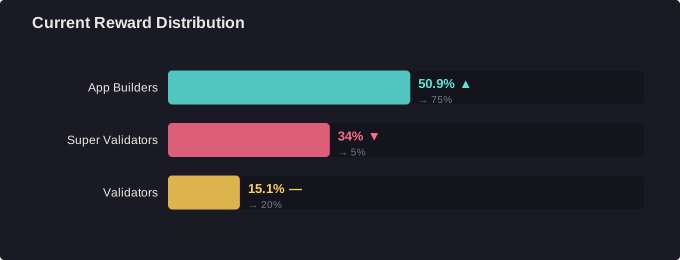
As of the latest data, the observed App Reward Share of all minted supply is approximately 50.9%. This will continue climbing toward 62-75% as the minting curve progresses. Some reward shares for App Builders are released through linear vesting mechanics to prevent large dumps and smooth out the supply impact.
The gatekeeping tension. The permissioned approval process is the most significant departure from the article’s original framing and from the Canton whitepaper’s vision of builders earning proportionally to value created without intermediaries. The Tokenomics Committee functions as a grants-committee-like gatekeeper — not for funding, but for reward eligibility. Canton’s rationale is that committee oversight prevents wash-trading and artificial fee generation (a real risk given the up-to-100x reward multiplier on Featured Apps). But the tradeoff is clear: the system that “pays its builders” only pays builders who pass a permissioned review process. This is closer to an institutional grants program with on-chain settlement than to the permissionless earning model described in the original tokenomics design. Whether the committee approval barrier is a reasonable fraud prevention measure or an unnecessary centralization point is an open question — and one the Canton community will likely revisit as the ecosystem matures.
Super Validators (~10-35% of rewards, decreasing over time)
Super Validators are the backbone of the Global Synchronizer. They are known institutions (currently 42 entities including Cumberland, Five North, MPC-Holding, and others) that run BFT consensus nodes, validate every CC transfer, and maintain the global state. They also operate the Canton Name Service and governance infrastructure.
Their reward share started at 80% and is now declining toward 5% at steady state. The observed share of minted supply is approximately 34.0%.
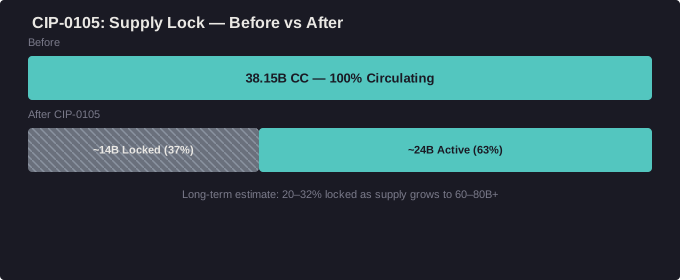
A major recent development is CIP-0105, approved on March 2, 2026. This governance proposal introduces a voluntary locking mechanism where Super Validators can lock a portion of their lifetime-earned CC rewards to maintain their “SV Weight” (governance influence). To maintain Tier 1 status, an SV must lock 70% of their earnings. The top 13 SVs collectively hold over 20.2 billion CC (~$3 billion at the time of approval), meaning roughly $2.1 billion worth of CC is now effectively removed from active circulation. Unlocks vest gradually over 365 days.
This is significant because it creates a supply sink. At today’s supply of ~38.15 billion CC, locking ~14 billion would represent roughly 37% of current circulating supply. However, analysts estimate the long-run lock at 20–32% of total supply, because the denominator will grow substantially — the minting curve will push total supply toward 60–80+ billion CC over the coming years, diluting the locked portion’s percentage share even as the absolute amount of locked CC grows. The 20–32% range also accounts for the fact that not all 42 SVs will necessarily maintain Tier 1 lock-up requirements, and that the SV share of future emissions drops from the current ~34% toward just 5% at steady state, meaning less new CC flows to SVs to be locked.
Validators (~15% of rewards)
Validators are user-facing nodes that participate in the Canton Coin ecosystem via decentralized applications. Unlike traditional proof-of-stake validators, Canton Validators only validate transactions they are a party to (a key privacy feature). They earn rewards through:
- Transfer activity: Proportional to the volume of user-initiated CC transfers they facilitate.
- Proof-of-life bonuses: For maintaining uptime and liveness on the network.
The observed Validator share of minted supply is approximately 15.1%. There are currently over 840 active Validator nodes.
Fee Structure: USD-Denominated, CC-Settled
One of Canton’s most institution-friendly design decisions is denominating all fees in USD while settling them through CC burns. This gives enterprises predictable cost structures (no surprise gas spikes in volatile token terms) while still tying the token’s value to real economic activity.
Important: the fee structure has changed significantly since launch. CIP-0078 (approved September 2025) eliminated all CC transfer and lock fees, setting them to zero. The original whitepaper described a regressive percentage transfer fee schedule (1.0% on the first $100, scaling down to 0.001% above $1M), plus per-UTXO base fees and coin locking fees. These are no longer active.
The fees that remain and generate the ~$2.4 million in daily burns are:
Synchronizer Traffic Fees (Primary Burn Source)
This is now the dominant fee mechanism, accounting for approximately 94.8% of all CC burns even before CIP-0078 removed the other fee types. Users prepay by burning CC to create a non-transferable traffic balance. Every state-changing transaction on the Global Synchronizer consumes traffic, making this a direct usage-based cost.
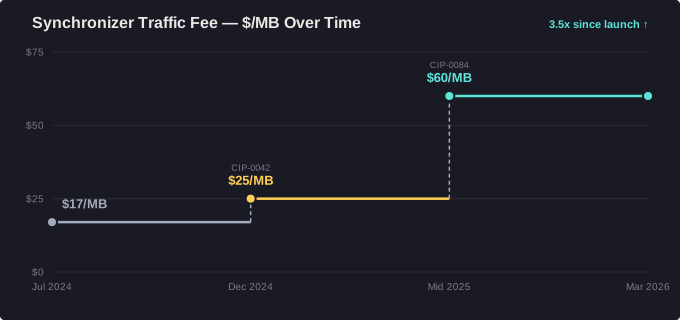
The per-MB rate has increased significantly since launch through governance: from $17/MB at genesis, to ~$25/MB after CIP-0042 (December 2024, adjusting for more efficient data representation in Canton 3.1), to the current $60/MB set under authority delegated to the Tokenomics Committee by CIP-0084. The 3.5x increase from launch reflects both growing demand management and the Committee’s mandate to maintain network stability during ramp-up. The current rate is visible in the on-chain synchronizer configuration as extraTrafficPrice: "60.0".
Holding Fees (Expiration Mechanism)
A $1 per year per UTXO holding fee accrues as a computed liability against the coin’s value, but — importantly — it is not deducted on transfer (that was the pre-CIP-0078 behavior). Since CIP-0078, the sole enforcement is through expiration: when accrued fees exceed a UTXO’s value, Super Validators can exercise Amulet_Expire to archive the coin contract, burning its entire remaining value. A $0.01 UTXO becomes expirable after roughly 3.65 days; a $1 UTXO lasts about a year. The mechanism’s primary purpose is dust prevention and discouraging UTXO fragmentation, not generating meaningful burn revenue.
Historical Fee Schedule (Pre-CIP-0078, Now Zero)
For context, the original transfer fee schedule was:
| Transfer Value (USD) | Fee Rate | Current Status |
|---|---|---|
| First $100 | 1.0% | Set to zero |
| $100 – $1,000 | 0.1% | Set to zero |
| $1,000 – $1,000,000 | 0.01% | Set to zero |
| Above $1,000,000 | 0.001% | Set to zero |
Base transfer fees ($0.03/UTXO) and coin locking fees ($0.005/lock holder) were also zeroed out. Holding fees ($1/year/UTXO) still exist but are no longer deducted on transfer — they now only trigger UTXO expiration when accrued fees exceed the coin’s value (see above).
All fee parameters are governed by two-thirds supermajority vote of Super Validators and apply only to future activity (never retroactively). The governance can reinstate fees if conditions warrant.
Current On-Chain Metrics (March 2026)
The numbers paint a picture of a network in its growth phase with meaningful traction:
| Metric | Value |
|---|---|
| Circulating Supply | ~38.15 billion CC |
| Market Cap | ~$5.5 billion |
| Price | ~$0.14–0.15 |
| All-Time High | $0.194 (Feb 3, 2026) |
| All-Time Low | $0.059 (Dec 6, 2025) |
| Daily Fees Burned | ~$2.39 million |
| Super Validators | 42 |
| Validator Nodes | 840+ |
| Burn/Mint Ratio | ~0.65–0.70 (climbing) |
| CoinMarketCap Rank | #19 |
| Tokenized Assets Supported | $6+ trillion |
| Daily Repo Trades | $280+ billion |
The burn/mint ratio deserves a closer look. At ~$2.4M/day burned and CC priced at $0.14–0.15, roughly 16–17 million CC are burned daily (~5.8–6.2 billion annualized). Against the current minting rate of 10 billion CC/year, the implied ratio is approximately 0.58–0.62. The reported 0.65–0.70 range may reflect slightly different measurement windows or recent upward momentum. Either way, the trend is clearly climbing (up from ~0.15 six months ago). Once this ratio crosses 1.0, the network becomes net deflationary. For live burn and mint tracking, see The Tie’s Canton Dashboard or CC Explorer.
It is also worth contextualizing the $2.4 million in daily burns against the network’s headline activity numbers. Canton supports $6+ trillion in tokenized assets and $280+ billion in daily repo trades, but the vast majority of this activity runs through private synchronizers that do not generate CC fees. The Global Synchronizer — and CC itself — captures only a fraction of the network’s total economic throughput. The token’s value trajectory depends on whether that fraction grows as institutional participants opt into the shared infrastructure layer.
Supply and Demand Dynamics: Projecting the Path Forward
The interplay between programmatic minting reductions and accelerating burn rates defines $CC’s forward trajectory. The most recent minting reduction kicked in around January 2026, dropping the annual rate from 20 billion to 10 billion CC per year. This coincided with rising network activity, creating a compounding effect on the burn/mint ratio.
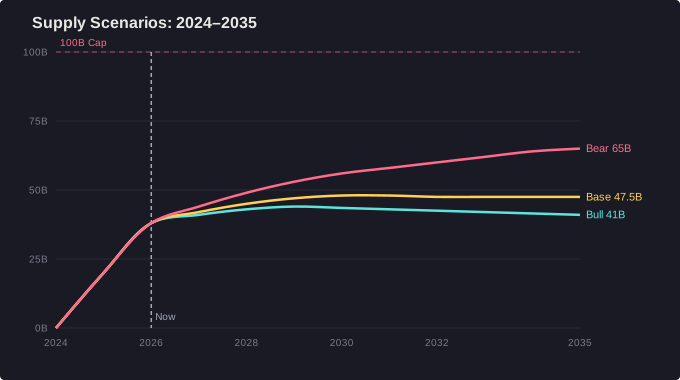
Three plausible scenarios emerge:
Base case (usage grows ~20% annually): The burn/mint ratio reaches 1.0 by late 2027. Supply stabilizes around 45-48 billion CC. The network enters equilibrium, with minting and burning roughly balanced at 2.5 billion CC per year after year 10.
Bull case (usage grows ~50% annually, driven by DTCC tokenization, JPM Coin integration, and institutional adoption): Net deflation begins after 2028. Supply peaks below 45 billion CC and then starts declining. The conversion rate appreciates meaningfully as fewer CC are needed to cover the same dollar volume of fees.
Bear case (usage growth stalls): Supply continues growing slowly toward the 100 billion 10-year cap, but the token retains a floor value tied to whatever fee volume persists. The BME still provides a natural price floor, it just settles at a lower equilibrium.
The Development Fund: Governance-Approved, Not Pre-Allocated
A common question arises: if there is truly no team allocation, how is ongoing development funded?
The answer arrived in February 2026 with the launch of the Canton Dev Fund, established through two governance proposals:
- CIP-0082 allocates 5% of all future CC emissions to the fund.
- CIP-0100 defines the governance, accountability, and distribution process.
This 5% is taken pro-rata across every reward stream (Super Validators, Validators, and App Builders). The network mints the normal amount, but 5% of what would have gone to participants is programmatically diverted to the Dev Fund.
Key characteristics:
- No retroactive or pre-mined tokens. The fund only touches future mints.
- Milestone-based grants. Recipients (external builders, security auditors, tooling developers) receive CC only after verifiable milestones are completed.
- Full transparency. Every proposal, review, and payout lives publicly in the GitHub repository.
- Independent oversight. Quarterly public reports and annual independent audits are required.
- Governance approval. Super Validators voted this into existence after the network was already live.
The fund is still in its earliest stage. As of late March 2026, no proposals have completed the full funding cycle yet, though a small number of early submissions are under active review.
An honest framing. The Dev Fund is governance-approved, milestone-gated, and transparent — materially different from a pre-allocated team treasury. But it is still an ongoing protocol-level allocation of 5% of all future emissions. Calling this “entirely consistent with zero allocation” requires a narrow interpretation: there was no pre-allocation, but there is now a post-launch programmatic allocation that functions similarly to ecosystem funds at other L1s. The key differences are timing (approved after launch by existing stakeholders, not embedded at genesis) and governance (milestone-based with public accountability, not discretionary). Whether this distinction is meaningful or semantic depends on your framework.
CIP-0105: Super Validator Locking and Its Supply Impact
Approved on March 2, 2026, CIP-0105 introduced a voluntary framework where Super Validators can lock a portion of their earned CC rewards to maintain governance influence. The mechanics:
- SVs elect to lock a percentage of their lifetime-earned CC rewards.
- The more they lock, the greater their “SV Weight” (governance power).
- To maintain Tier 1 status, 70% of all lifetime rewards (both historical and future) must be locked.
- Unlocks vest gradually over 365 days, preventing sudden dumps.
- Non-compliant validators face reduced rewards and governance influence.
- Enforcement is currently transitional (weekly compliance checks), with full on-chain automation planned for Phase 2.
The supply impact is substantial. The top 13 Super Validators hold over 20.2 billion CC. At 70% lock-up, that removes roughly $2.1 billion from active circulation. Going forward, approximately 14% of all future emissions will be locked by SVs.
The Canton Foundation described CIP-0105 as replacing “reputational assurances with cryptographic proof of alignment.” It transforms SV governance weight from a function of institutional reputation into a function of verifiable, economic skin in the game.
Anti-Speculation by Design: How Canton Actively Discourages Holding for Hype
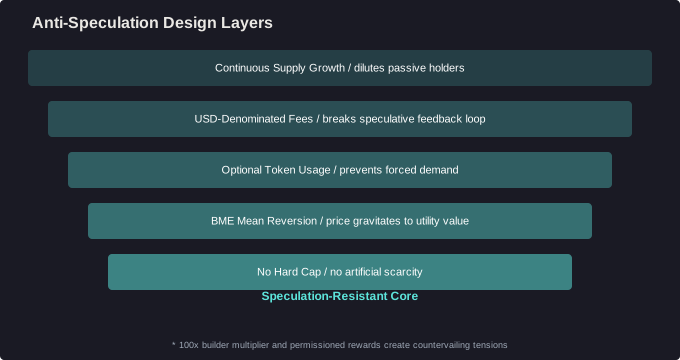
Most L1 tokenomics either ignore speculation or quietly benefit from it. Canton’s whitepaper is explicit: the system is designed to disincentivize holding tokens purely for speculative reasons. This is not a vague aspiration. It is built into the mechanics at multiple levels.
Continuously increasing supply dampens speculative hoarding. Because new CC is minted every 10 minutes, anyone holding CC without generating utility is being diluted. Unlike fixed-supply tokens where scarcity alone can drive price appreciation, Canton’s supply only stops growing when burns match mints. Sitting on CC without using the network means watching your share of total supply shrink.
USD-denominated fees decouple usage costs from token price. Institutional users care about predictable costs in dollars, not volatile gas prices. By pricing fees in USD and converting to CC at the current rate for burning, Canton eliminates the feedback loop where rising token prices increase usage costs, which in turn attracts speculators betting on further price increases. If $CC price spikes above its utility value, fewer tokens need to be burned per transaction, minting outpaces burning, and supply inflation pushes the price back down.
CC is optional, not mandatory. Canton Coin is not required to use the Canton Network. Parties can connect and transact directly using private synchronizers without touching CC at all. The Global Synchronizer and CC are opt-in infrastructure. This means $CC cannot derive value from forced demand (unlike ETH for Ethereum gas), only from genuine utility preference. This cuts both ways: it is anti-speculative because demand cannot be artificially forced, but it also means that fee-driven value accrual is not structurally guaranteed. If institutions find private synchronizers sufficient for their needs, the Global Synchronizer — and by extension CC — could remain a sideshow to the network’s actual transaction volume. The $6 trillion in tokenized assets and $280 billion in daily repo trades largely flow through private synchronizers today, producing only ~$2.4 million in daily CC burns. That is a conversion rate of roughly 0.00004% of stated network activity into CC fee demand.
No artificial scarcity triggers. There is no hard cap on supply. There are no token burns designed to create FOMO. The minting curve is transparent and predictable. The whitepaper explicitly states that the goal is for the conversion rate to always tend toward a point that matches the utility provided by the ecosystem, not to create speculative bubbles.
The BME acts as a mean-reversion engine. If the market bids CC above its intrinsic utility value, the system responds: fewer CC are needed to cover the same dollar fees, burns slow down, minting continues at pace, net supply increases, and the price corrects downward. If CC trades below utility value, the opposite occurs. This creates a natural gravitational pull toward fundamental value that active speculators must fight against.
The cumulative effect is a token with meaningful structural resistance to pure speculation. You cannot corner CC supply because it is always expanding. You cannot force demand because usage is optional. You cannot benefit from artificial scarcity because there is none.
But “anti-speculation” has limits. The 100x builder reward multiplier (discussed above) creates its own speculative incentive loop. The BME’s mean-reversion depends on market participants responding rationally to supply signals, which is an assumption, not a guarantee. And the optional nature of CC, while preventing forced demand, also means the token’s utility floor is only as strong as the voluntary adoption of the Global Synchronizer. The design is genuinely hostile to pump-and-dump dynamics, but it is not immune to all forms of speculative behavior.
How Canton Compares: $CC vs. $HYPE (Hyperliquid)
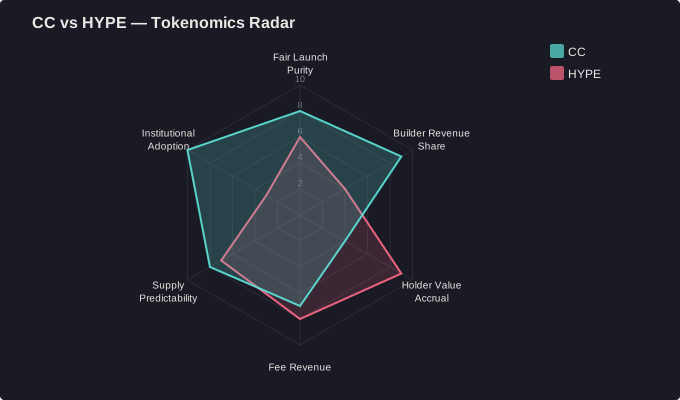
Hyperliquid’s HYPE token is perhaps the closest recent comparable, both launched without VC allocations and tie token value to real fee revenue. But the two take fundamentally different paths to the same destination.
| Dimension | Canton Coin ($CC) | HYPE (Hyperliquid) |
|---|---|---|
| Launch model | No pre-allocation. 100% minted via utility. But early emissions heavily concentrated: 80% to 42 permissioned Super Validators in first 6 months. | Community-first. 31% airdropped to 94K early users. 0% VC, but 23.8% to team (vested). |
| Supply model | No hard cap. Dynamic BME targets 2.5B CC/year at steady state. Supply self-regulates. | Fixed 1B total cap. Deflationary via buybacks and burns. |
| Fee value accrual | Traffic fees burned. New CC minted and distributed to Featured Apps (committee-approved), validators, and SVs. Protocol-level builder rewards, but gated by permissioned approval process since CIP-0078. | 97% of trading fees buy back HYPE (often burned/locked). Value flows to all holders. Builders can earn separately via “builder codes,” an on-chain fee attribution system where third-party apps charge up to 0.1% on perp trades they route (over $40M in cumulative builder code revenue as of early 2026), but this is an opt-in application-layer mechanism, not protocol-level reward sharing. |
| Team allocation | None. | 23.8% to core contributors, 1-year lock + multi-year vesting. Ongoing unlocks create periodic sell pressure. |
| Target use case | Institutional RWA tokenization, payments, settlements. Privacy-focused. | High-frequency DeFi perpetual trading (retail + pro). Fully permissionless. |
| Stability mechanism | BME feedback loop, price gravitates toward intrinsic utility value. | Aggressive buybacks + fixed supply create scarcity/deflation. |
| Current revenue | Approx. $875M annualized in fees burned ($2.4M/day). | $550M+ annualized trading fee revenue. |
| Key strength | Strong anti-speculation design (continuous supply, optional token, USD fees, BME mean-reversion), though 100x builder multiplier and permissioned distribution create countervailing tensions. | Proven revenue powerhouse. One of strongest “real yield” DeFi models. |
Both succeed at tying token value to real fees, a welcome departure from the speculation-driven norm. Canton is the institutional-grade evolution, optimized for slow, stable growth with builders as the primary beneficiaries. HYPE is the retail DeFi version, optimized for aggressive holder returns through concentrated trading volume.
Neither is perfect. Canton’s model is still early in proving adoption beyond institutions. HYPE faces unlock-related volatility and debates over future emissions. But both represent meaningful progress toward tokenomics that reward utility over hype.
Where to Track Canton On-Chain Data
Canton’s privacy-first architecture means it does not appear on Dune Analytics. Instead, purpose-built analytics platforms provide comprehensive coverage:
- The Tie Canton Dashboard: Real-time supply, fee burn charts, reward leaderboards, and 30-day breakdowns. The go-to for quick overviews.
- Cantonscan: Full block explorer with transactions, parties, governance proposals, and featured apps.
- CC Explorer: Live validator data, circulating supply, consensus height, and governance snapshots.
- Sync Insights: AI-powered analytics with natural language queries and custom dashboards. The closest thing to a “Dune-like” experience for Canton.
- Coin Metrics: Professional-grade structured on-chain data for institutional financial analysis.
Exchange Availability
Spot trading for $CC launched on November 10, 2025, across approximately 11 exchanges and has since expanded to 15-17 centralized exchanges. Daily spot volume typically ranges between $12-17 million.
Top venues by volume: Bybit (CC/USDT, $4.5M daily), OKX (CC/USDT, $2.2M), Kraken (CC/USD and CC/EUR fiat pairs, $1.2M), KuCoin ($854K), and MEXC ($644K). Kraken’s fiat pairs are particularly notable for institutional access.
Futures and perpetuals are available on Binance Futures, OKX Futures, Bybit Futures, KuCoin Futures, and Hyperliquid, among others. Binance spot listing and Coinbase listing remain absent as of this writing.
Key Catalysts on the Horizon
Several developments could materially accelerate the BME trajectory:
DTCC U.S. Treasury Tokenization MVP (H1 2026). The Depository Trust & Clearing Corporation is building a minimum viable product to tokenize U.S. Treasury securities on Canton. If successful, this could bring trillions in traditional asset settlement onto the network, dramatically increasing fee burns.
JPMorgan Kinexys / JPM Coin Integration (phased through 2026). JPMorgan’s deposit token is undergoing native integration on Canton for institutional settlement. This deepens Canton’s regulated digital cash rails.
LayerZero Cross-Chain Integration. Goldman Sachs-backed Canton has partnered with LayerZero for cross-chain asset transfers, potentially expanding the universe of assets and users interacting with the Global Synchronizer.
CIP-0105 Phase 2 (on-chain enforcement). Once SV locking contracts deploy to Mainnet, governance weight updates become fully automated and continuous, making the supply lock permanent and verifiable.
Minting curve progression. The current phase (1.5-5 years) allocates 62% of rewards to Application Builders. This share will rise to 69% after year 5 and 75% after year 10, progressively increasing the incentive for developers to build on Canton.
Conclusion: A Different Kind of L1
Canton Coin’s tokenomics represent a genuine departure from the patterns that have defined crypto for the past decade. The absence of pre-allocated insider tokens is real. The burn-and-mint equilibrium is a thoughtful self-correcting design. The builder reward share is structurally unique among L1s.
But the model carries real tensions that honest analysis cannot ignore. The “fair launch” distributed 80% of early emissions to 42 permissioned institutions — earned, not gifted, but concentrated nonetheless. The token is optional for network usage, meaning fee-driven value accrual depends entirely on voluntary adoption of the Global Synchronizer. The 100x builder multiplier creates gaming incentives that cut against the anti-speculation narrative. The BME’s equilibrium logic assumes market prices respond to supply dynamics, which is a reasonable incentive design but not a mechanical guarantee. And the Dev Fund, while governance-approved and transparent, is a 5% ongoing emission allocation by another name.
The institutional pipeline is real (DTCC, JPMorgan, Goldman Sachs, Nasdaq, Euroclear), but the conversion from headline network activity ($6T+ in tokenized assets) to actual CC demand (~$2.4M/day in burns) reveals how early this ecosystem still is. The network is 20 months post-genesis with a burn/mint ratio that has not yet reached equilibrium.
What Canton gets right is the direction: builders earn proportionally to value created, supply is tied to real activity, and the protocol explicitly discourages speculation over utility. Whether the execution matches the ambition will depend on how much institutional activity migrates from private synchronizers to the Global Synchronizer in the coming years.
For an industry saturated with token models that reward insiders and speculators over builders, Canton’s design — warts and all — is worth studying closely.
Disclaimer: This article is for informational and educational purposes only. It does not constitute financial or investment advice. Always conduct your own research before making any investment decisions.
