Every feature that makes TAO’s tokenomics elegant also makes them economically fragile, and you can’t really understand the token without holding both facts at once. Hard cap and fair launch give you Bitcoin-grade scarcity. Flow-based emissions give you a market-driven capital allocation engine. Subnet AMMs give you real-time price discovery on AI verticals. But the same mechanisms push value accrual out to subnet-level off-chain revenue that neither accrues to base-layer holders nor, at current verifiable levels, comes close to justifying the subsidy the network pays out.
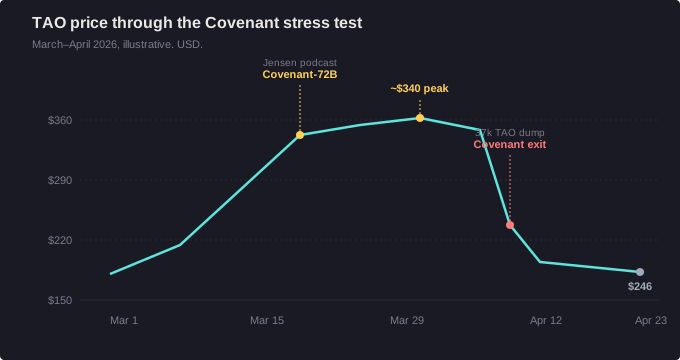
The last six weeks made that tension concrete. TAO ran from $180 to $340 on the back of Covenant-72B, a 72B-parameter LLM trained permissionlessly across Subnet 3, then fell back into the $240s after the Covenant AI team publicly quit and dumped about 37,000 TAO (~$10M). At $246 today, the token sits 67% below its 2024 all-time high of $757, so the Covenant dump was a 20-30% move inside what was already a multi-year de-rating. The story isn’t that the network broke. The story is what a fair stress test reveals about which parts were load-bearing.
This piece covers: supply mechanics, how dTAO actually works, where the subsidy math breaks (and where Pine Analytics’ bear case may overstate itself), the Covenant fallout, BIT-0011, competitor tokenomics including the direct training-subnet rivals outside Bittensor, the regulation picture, explicit scenario math, and a range of fair values under each branch.
Supply: Bitcoin-shaped, with a twist
TAO has a hard cap of 21,000,000, no pre-mine, no VC allocation, no ICO. Every token has been mined through network participation since January 2021. That’s actually uncommon. Most “decentralized” projects have 20-70% of supply sitting with founders and funds, which is why post-unlock cliffs dominate their charts.
Block time is 12 seconds (7,200 blocks/day). The first halving fired on December 14, 2025 when total issuance crossed 10.5M TAO. Block rewards dropped from 1 TAO to 0.5 TAO, taking daily emissions from ~7,200 to ~3,600 and annual issuance inflation from ~10% to ~5%. Circulating supply in mid-April 2026 is ~10.85M, about 52% of max. About 67-70% of that is staked, which means the liquid float is roughly 3.3M TAO, materially smaller than the $2.7B headline market cap suggests.
Halvings are issuance-triggered, not date-triggered. Each one aims for the next 10.5M milestone, so real-world timing depends on recycling along the way. Subnet registration fees, certain burns, and some other flows get returned to the unissued pool rather than permanently destroyed, which extends the gap between halvings. Best current estimate for halving #2 is December 2029 at 0.25 TAO/block, but recycling dynamics make that a range (2028-2030) rather than a fixed date.
Subnets run their own alpha halvings in parallel. Each alpha has its own 21M cap and halving schedule that starts from subnet creation. When a TAO halving fires, alpha injected into subnet pools halves (injection is proportional to TAO flows), but alpha rewards to miners, validators and owners are unaffected. A TAO halving hits pool depth, not participant payouts. This decoupling matters when you model subnet economics post-halving, because the squeeze shows up as slippage and scarcity, not as a direct compensation cut.
dTAO and the alpha token system
The February 2025 dTAO upgrade is the most consequential change to Bittensor since the Finney launch. Before dTAO, a council of 64 validators voted on how TAO emissions were split across subnets. After dTAO, every subnet got its own alpha token and its own AMM pool, and the market allocates emissions via net TAO flows.
Each subnet’s AMM has two reserves: TAO on one side (τ_in), alpha on the other (α_in). Staking TAO swaps it for alpha at the current ratio. Alpha price = τ_in / α_in. Alpha held outside the pool by participants (α_out) is also the subnet’s “total stake.” Each pool starts with negligible liquidity (1e-9 alpha), so early price discovery is purely market-driven and slippage is real.
A November 2025 update shifted cross-subnet emissions from price-based weighting to flow-based weighting, sometimes called Taoflow. The weight each subnet receives is driven by an exponential moving average of net TAO flows (staking minus unstaking), with roughly a 30-day half-life. Positive net flows share emissions proportionally. Negative net flows get zero. This is hard to game because repeatedly staking and unstaking through the AMM costs slippage.
The result is a flywheel: usage and conviction pulls TAO into a subnet’s reserve, pushes alpha price up, attracts more emissions, feeds miners and validators, produces more AI value (in theory), pulls in more TAO. Weak subnets do the reverse until they die. The elegance of this design is also why value accrual is hard. Emissions allocate within the network based on flows, but that doesn’t translate subnet revenue into TAO holder cash flow. The flywheel pushes more TAO into successful subnets’ reserves, which lifts alpha prices, but TAO holders only benefit if they’re staked into those specific subnets.
For TAO holders there are two paths. Root (Subnet 0) has no alpha; staking TAO to a root validator gives subnet-agnostic exposure weighted across every subnet where that validator is active, paying in TAO. Alpha staking is subnet-specific, higher variance, higher ceiling, pays in alpha. Validator stake weight blends both, TAO at root plus alpha in the subnet, so picking your staking path is really picking your risk dial.
How emissions actually split
Each block’s emission is injected into the subnet pool (TAO into τ_in, alpha into α_in), then distributed at the end of each tempo (~72 minutes, 360 blocks) via Yuma Consensus. The standard split of participant-bound alpha:
- 41% to miners, scored on output quality
- 41% to validators and their delegators
- 18% to the subnet owner
Subnet owners can tweak this up to a cap using “mechanism” configurations, but most run near defaults. Validators typically distribute about 82% of their rewards to delegators.
The subsidy problem, and where the bear case overstates
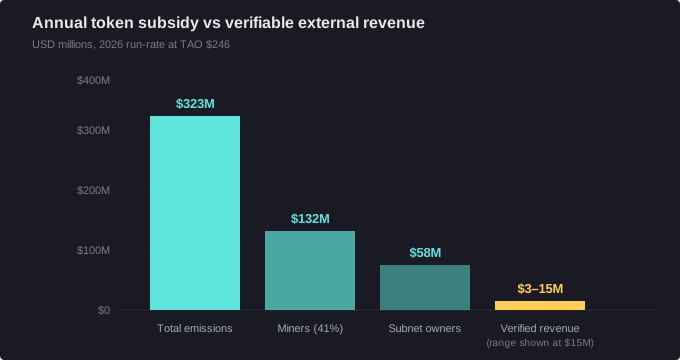
At current prices (~$246) and post-halving emissions (3,600 TAO/day), the network pays out ~$323M per year in token inflation to participants. Of that, ~$132M to miners, ~$132M to validators and delegators, ~$58M to subnet owners. The most rigorous independent estimate of external, paid, customer-funded revenue across all 128+ subnets is $3-15M per year. Miners alone receive 10-40x more in token subsidy than the entire network earns from paying customers.
Pine Analytics has done the most forensic work on this, and their single-subnet numbers are sharp. Chutes (SN64), the largest subnet at ~14.4% of emissions, earns ~$52M in annual TAO subsidy against $1.3-2.4M in verifiable external revenue. That’s 22:1 to 40:1. Chutes serves ~5M daily inference requests at prices 85% below DeepSeek and Together AI. Strip out the subsidy and Chutes inference would cost 1.6-3.5x more. So the 85% cost advantage is not structural; TAO holders fund it through inflation.
This is the core bear case, and it’s largely correct on the math. But it rests on a counterfactual worth pushing on: would most Chutes users switch to centralized alternatives if the subsidy went away, or would they simply stop using Chutes?
Pine’s ratio implicitly assumes Chutes’ ~5M daily requests represent price-elastic demand that would migrate to DeepSeek/Together at higher pricing. That’s the scenario where the subsidy is just a customer-acquisition spend and the underlying demand is durable. It’s also the optimistic scenario for Bittensor skeptics, because it implies a real market exists underneath the subsidy.
The less-discussed alternative is that Chutes’ usage is heavily skewed toward crypto-native developers, permissionless-access use cases that centralized providers won’t serve (content moderation edge cases, jurisdictional constraints, no-KYC workflows, onchain AI apps calling inference APIs from smart contracts), and testing/experimentation traffic that only exists because the pricing is free-ish. Under this scenario, 30-60% of current usage evaporates entirely if the subsidy goes away. That’s worse for the “sustainable marketplace” thesis but better for the “what exactly is the subsidy buying” question, because it means the subsidy is creating demand rather than just price-arbitraging it.
Neither side has the data to settle this. We don’t have telemetry on what fraction of Chutes’ 5M daily requests come from users who would or wouldn’t migrate. Saying confidently that Chutes has 22-40x subsidy-to-revenue is technically accurate; saying confidently that this means Bittensor is pricing below its unsubsidized cost structure requires assumptions about demand composition that nobody has actually measured.
Targon (SN4) is the less-ambiguous case. Manifold Labs raised a $10.5M Series A, the subnet is projected at ~$10.4M in annual revenue against ~$18M in emissions (1.7:1 ratio), and Dippy AI (8.6M users) migrated its entire backend to Targon. That last point is a real signal. Dippy had every option to use centralized providers and chose not to. For the bull case, Targon is the existence proof; for the bear case, it’s one data point against 127 subnets that don’t look anything like it.
A $43M quarterly (~$170M annualized) network-revenue figure circulates in promotional outlets. It would invert the subsidy ratio entirely if true. It doesn’t reconcile with the subnet-by-subnet audits and I haven’t seen the primary source that produced it, so I treat it as unverified until there’s a publicly documented methodology. But I flag it because dismissing it completely when it’s repeatedly cited is also a mistake. It might turn out to be right. It might be a methodology error. Either way, until an independent dashboard covers all 128 subnets, the real network revenue sits in a range from $3M to potentially $170M, and both tails matter for valuation.
The subnet landscape, and the real training competitors
As of mid-April 2026, 128 subnets are active with a planned expansion to 256 later this year. Cumulative alpha token market cap is $1.1-1.5B, about 25-35% of TAO’s own market cap. The top 10 subnets account for ~56% of emissions and ~$712M of combined alpha cap. Stake concentration inside individual subnets is severe, with Gini coefficients often at 0.95+.
Three subnets matter disproportionately.
Templar (SN3) is the LLM pre-training subnet, ex-Covenant. Delivered Covenant-72B in March 2026: 72B parameters trained across 70+ independent nodes on commodity hardware, scoring 67.1 on MMLU (Llama 2 70B range). The enabling tech was SparseLoCo, which compressed gradients by ~97% without losing accuracy. Jensen Huang name-checked this on a podcast and kicked off the March rally. Community operators are now continuing SN3 independently and have announced Teutonic-I, a follow-up aiming at 1T-parameter scale.
Chutes (SN64) is the serverless AI compute subnet, run by Rayon Labs. High usage, high subsidy, thin revenue. Rayon also operates SN19 (Nineteen, high-frequency inference) and SN56 (Gradients, model training). Together the “Rayon Trio” captures ~23.7% of emissions. A single team controlling nearly a quarter of the incentive distribution is a decentralization problem that gets less airtime than the Covenant drama but is arguably more structural.
Targon (SN4) is confidential compute, run by Manifold Labs. Enterprise-grade, Series A backed, Dippy AI as anchor customer. The most believable revenue story in the ecosystem.
Others worth tracking: Basilica (SN39) and Grail (SN81), both ex-Covenant subnets being taken over by community operators. Hermes (SN82) is building agent-to-agent tooling. Lium (SN51) is short-term GPU rental with validator-verified hardware specs. Score (SN44) caught a PwC France alliance earlier this year for physical AI work.
One point that gets elided when comparing TAO to DePIN compute plays: Bittensor’s closest competitors on the specific decentralized-training claim aren’t Render or Akash, they’re Prime Intellect and Nous Research. Prime Intellect’s INTELLECT-2, released May 2025, is a 32B-parameter reasoning model trained via globally distributed asynchronous reinforcement learning across permissionless contributors. Their PRIME-RL framework, TOPLOC (rollout verification) and SHARDCAST (weight distribution) solve the same bandwidth problem SparseLoCo solves for Bittensor, with different trade-offs. Nous Research raised $50M led by Paradigm in April 2025 for Psyche, built around their DisTrO optimizer that similarly reduces inter-node bandwidth during training.
Covenant-72B is a larger parameter count, but INTELLECT-2’s RL training is arguably a harder coordination problem, and Nous’s Psyche has $50M of institutional conviction behind it from a top-tier crypto VC. Bittensor’s advantage in this niche is narrower than the Jensen-Huang-endorsement narrative suggests. If the decentralized-training category becomes valuable, TAO is one of at least three serious contenders. None of the three has a clear moat. All three are open-source and can theoretically adopt each other’s innovations.
Governance and the Covenant AI exit
Bittensor’s governance has two layers. At the top is a three-signer multisig called the triumvirate, which signs off on protocol upgrades and emission-level decisions. Below that sits a 12-validator Senate that votes on proposals. In practice, proposals originate from the Opentensor Foundation and the Senate has historically approved quickly.
On April 10, Covenant AI founder Sam Dare published a thread announcing withdrawal from Bittensor and accused co-founder Jacob Steeves of running what he called “decentralization theater.” The specific allegations: unilateral suspension of emissions to Covenant’s three subnets (SN3, SN39, SN81), stripping moderation rights over Covenant’s own community channels, unilateral infrastructure deprecation without process, coercive timed token sales used as economic pressure, and effective centralized control via the triumvirate with co-signers acting as legal shields.
Within hours, Dare sold 37,000 TAO ($10M) in two clips. TAO dropped 15-30% from its $337-351 highs into the $254-263 zone inside 48 hours.
Steeves’ response was public and detailed: acknowledged selling a much smaller amount (~1% of his alpha holdings, targeted at subnets running near-100% burn code), said he doesn’t have unilateral control over emissions, said the moderation timeout was temporary and already reversed, said he didn’t know what the “deprecating infrastructure” allegation referred to. Pointed to a prior 2,000 TAO grant to Covenant plus additional personal investment.
Both parties have institutional incentive to spin this. Dare controls the narrative with a dramatic thread; Steeves controls the narrative with an apologetic reply. Both framings are self-serving. The only thing that settles which version is closer to true is on-chain evidence, and the most-cited piece of that evidence is the claim that Steeves was the effective mover on 38 of 41 network upgrades between 2023 and 2026, with co-signers approving within minutes and no documented public discussion.
I have not independently verified 38/41. It’s circulated in multiple post-Covenant analyses but I haven’t seen a specific on-chain data source with the full upgrade list. If it’s accurate, the triumvirate-as-polite-fiction critique holds regardless of founder drama, because the structural concentration is what matters, not the personal dynamics. If it’s inflated or cherry-picked, the governance situation is less dire than the narrative suggests. Either way, the claim is on-chain verifiable and someone in the ecosystem should do that audit publicly. Its absence is part of the problem.
My read, with that caveat: founder drama and real structural centralization are not mutually exclusive, and you should price in some of both. The Covenant exit by itself isn’t the story. The story is that the network’s governance model had no routine mechanism for a subnet operator to contest emission decisions before it escalated to a public exit and $10M dump. That’s a structural gap regardless of who was right in this specific case.
BIT-0011: locked stake and conviction
BIT-0011 is still draft-stage, announced by Steeves at the April 16 open call and not yet formalized in the opentensor/bits repo.
Core idea: subnet ownership becomes a continuous, on-chain contest of verifiable long-term commitment. Participants voluntarily lock alpha tokens on a subnet for a chosen duration. Locked amount times remaining duration produces a conviction score. The staker (or delegated pool) with the highest EMA-smoothed conviction controls the subnet and captures the 18% owner emissions.
The simplest formulation published so far is linear decay:
C(t) = L × (1 - t/T)
where L is the locked amount, T is lock duration, t is time elapsed. Conviction starts at L (100%) and decays to zero at expiry. Every 30 days the protocol computes an EMA to smooth short-term spikes. Some summaries describe a triangular profile (ramp up in the first half, decay in the second) to prevent flash takeovers. The AMA suggested that’s still being finalized.
Rollout starts on the three ex-Covenant subnets (SN3, SN39, SN81), then expands to other mature high-liquidity subnets, then potentially to new subnets with an immunity period for bootstrapping.
What BIT-0011 does well: Covenant-style exits get expensive. An owner who wants to dump has to either let conviction decay (losing ownership first) or re-lock capital continuously, so the exit is visible, gradual and auditable. Challengers are real: any staker with enough locked alpha can take over a malicious or absent owner without a multisig vote. More alpha gets locked long-term, creating deflationary pressure on subnet tokens.
What BIT-0011 doesn’t fix: the triumvirate multisig at the protocol layer is untouched. Emissions can still be suspended at the root. The “effective single signer” critique survives the proposal entirely. Capital intensity rises, starting and keeping a subnet gets harder if you have to lock liquid capital to defend your own ownership, arguably an over-correction for one incident. And it introduces new attack surfaces, coordinated whale attacks on small low-liquidity subnets outside the immunity window become a live threat. EMA smoothing helps but doesn’t eliminate this.
Net read: BIT-0011 is a good proposal for a specific failure mode, not a governance overhaul. Framing it as the fix for “decentralization theater” oversells it. It fixes sudden subnet-owner exits, which is narrower.
Tokenomics vs. competitors
Five most-cited comparables, scanned on the dimensions that actually differentiate them:
| Project | Max supply | Insider allocation | Deflation mechanism | Revenue → token link | Key weakness |
|---|---|---|---|---|---|
| TAO | 21M (hard) | 0% (fair launch) | Halvings on issuance + fee recycling | None direct. Emissions redistribute to subnets via Taoflow | Subsidies dwarf verifiable revenue 10-40x |
| Render | ~533M (no cap) | ~41% team/treasury/investors | BME: each render/AI job burns RENDER | Direct. Usage removes supply 1:1 | Legacy VC unlocks still weighing |
| Akash | 388.5M | ~18% team + investors | BME activated March 2026. Compute leases burn AKT | Direct. Every lease burns | Still inflationary base layer |
| io.net | 800M | ~34% backers/contributors | IDE (Q2 2026): ≥50% of revenue burned, USD-stable supplier rewards | Direct. Revenue-indexed burns | Heavy unlocks through 2030 |
| ASI (FET) | None | ~17% founders/foundation | Earn & Burn, $50M committed | Indirect. Revenue-based buyback-and-burn | Merger overhang, high dilution |
Where TAO wins: fair launch purity has no real peer among serious projects, the hard cap is real, the staking ratio is healthy, and flow-based emissions suit a marketplace-of-marketplaces better than straight revenue-burns would.
Where TAO loses right now: zero direct revenue accrual. Render, Akash and io.net all have mechanisms where external paid usage improves token economics. TAO’s mechanism is “emissions flow to subnets that attract TAO inflows” and subnet revenue stays off-chain and off-holder-balance-sheet.
The tokenomics purity is also the structural weakness. A BME-style revenue capture mechanism, even at the subnet level, would change the valuation math. Nobody has seriously proposed one. That’s either ideological resistance or real disagreement about whether marketplaces can accrue value to base-layer tokens at all. Both might be true.
Regulation: tailwind at the base, specific snags at the token level
The base-layer picture is much better than the “SEC-is-coming” framing suggests. Paul Atkins replaced Gensler as SEC Chair in April 2025. The SEC-CFTC joint Interpretive Release on March 17, 2026 produced a five-category token taxonomy (digital commodities, collectibles, tools, stablecoins, digital securities) where only digital securities remain subject to securities laws. Atkins explicitly said “most crypto assets are not themselves securities.” Project Crypto and the March 11 SEC-CFTC MOU have shifted the posture from enforcement-first to coordinated rulemaking. DOGE, SOL, and XRP spot ETFs are live. PoS staking and liquid staking have both been declared outside securities law. The GENIUS Act passed, CLARITY passed the House and awaits the Senate. For TAO specifically, the ETF path through Grayscale’s GTAO is real rather than aspirational.
So this is the wrong moment to write “regulation is a quiet overhang” in the 2023 sense. The tailwind is real. What’s interesting is that the new framework, because it’s clearer, actually surfaces two specific TAO-level issues that the old uncertainty regime papered over.
First, the Interpretive Release spells out when a non-security crypto asset becomes subject to an investment contract and, importantly, when it ceases to be. The test hangs on economic reality and active ongoing efforts of an identifiable team. Bittensor’s triumvirate multisig, Opentensor Foundation-led upgrades, and Foundation-directed grants are exactly the kind of facts the new framework is designed to evaluate. A network where one signer moved 38 of 41 upgrades (if that claim holds) looks materially different under “economic reality trumps labels” than under the old enforcement-by-vibe regime. TAO probably ends up classified as a digital commodity, but the path to getting there may require more decentralization than currently exists, and Grayscale’s own April 2, 2026 S-1/A still lists “potential classification of TAO as a security” as a live risk factor. Grayscale has every incentive to minimize risk-factor language. That it survived the amendment tells you something.
Second, subnet alpha tokens look more like investment contracts under the 2026 framework, not less. The 18% perpetual emissions to subnet owners for ongoing team efforts, distributed to retail participants through dTAO AMM deposits, hits every element of the Howey test the Interpretive Release reaffirms. “Economic reality trumps labels” cuts against alpha tokens even in a pro-crypto SEC. The new framework also clarifies when investment-contract status ends, which is useful for subnets that successfully decentralize, but most subnet teams are nowhere near that threshold. A single enforcement action, or even guidance targeting one prominent subnet, would ripple across the 128-subnet ecosystem fast.
Third, tax treatment on alpha staking, root staking, and alpha-to-TAO swaps still lacks clean IRS precedent. That’s independent of the SEC-CFTC framework and it’s an underwriting problem for any US-based institutional allocator regardless of how crypto-friendly the securities regulators are.
The DCG conflict-of-interest issue in the GTAO structure remains flagged in the S-1/A. Yuma’s contribution to 14 subnets creates a structural conflict if GTAO gets approved, because DCG is economically interested in TAO price across both the ETF sponsor role and the subnet operator role. That’s a governance and disclosure problem, not a securities-classification problem, and it’s largely orthogonal to the Atkins SEC’s posture.
Net read: base-layer regulation is a genuine tailwind, probably the best regulatory environment TAO will ever have. The specific TAO-level risks that survive the new framework are governance concentration (which the new framework makes easier to evaluate, not harder) and subnet alpha tokens looking like unregistered offerings under a clearer Howey test. Neither is fatal. Both get more visible, not less, as the rules clarify.
Scenario math: what the numbers actually do under stress
Rather than probabilities, here’s what the tokenomics look like under four straightforward scenarios. These are illustrative point calculations at current parameters, not forecasts.
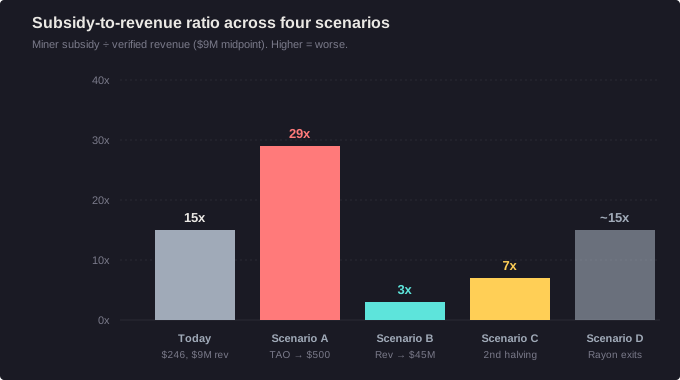
Scenario A: TAO doubles to $500
- Daily emissions: 3,600 × $500 = $1.8M/day = $657M/year total emission value
- Miner subsidy: $657M × 0.41 = $269M/year
- If external revenue stays at $9M midpoint, subsidy/revenue ratio goes from 15x to 29x. Gets worse.
- Subnet token values rise in TAO terms, which could attract more capital and could grow revenue. But dollar-denominated subnet revenue doesn’t automatically scale with TAO price.
Scenario B: External revenue grows 5x to ~$45M/year
- At current TAO price, miner subsidy stays ~$132M/year
- Ratio drops from 15x to 3x. Meaningfully better, still structurally unusual.
- Requires specific subnets converting emissions into paid usage. Targon-style revenue growth across 5-10 more subnets gets you there.
- This is what the bull case needs to look like.
Scenario C: Second halving fires at current TAO price
- Daily emissions: 1,800 TAO at $246 = $162M/year total, $66M to miners
- If revenue holds at $9M, ratio drops from 15x to ~7x. Still bad but less fatal.
- Low-margin subnets (Chutes in particular) face a price-or-exit decision. Hiking prices exposes the real cost structure; exit deflates the flywheel.
- If price doubles by then (Scenario A + C), subsidy dollar value recovers to ~$132M. You’re back where you started from a subsidy perspective.
Scenario D: Rayon Trio exits Covenant-style
- Rayon controls ~23.7% of emissions, $77M/year at current prices
- Covenant controlled ~14% and the exit triggered a 20-30% price drop
- A proportional Rayon exit would likely be worse, conservatively 30-45% price impact at announcement
- Remaining network picks up Rayon’s emissions share via Taoflow redistribution, so capacity isn’t structurally impaired. The question is whether the remaining teams are credible enough to absorb the rotation.
What these numbers show, and what most holders don’t model: TAO price and subsidy-ratio health move in opposite directions unless revenue scales in step. The subsidy is denominated in TAO, the revenue is denominated in USD. Token appreciation without matching revenue growth makes the fundamental picture worse, not better.
Valuation, with an actual view
TAO trades ~$246 as of April 23, market cap ~$2.7B, FDV ~$5.2B. Against the $3-15M external revenue range, that’s a market-cap multiple of 180-900x and an FDV multiple of 347-1,733x. CoreWeave and Lambda raised at 15-25x forward revenue. That comparison isn’t perfectly fair, centralized AI compute trades on predictable capex-heavy cash flows while crypto networks trade on network-effect optionality, but it’s in the right zip code.
A more generous crypto-native framing: BTC trades at infinity-times revenue because it has none. ETH at peak traded at ~20-30x on-chain fees. SOL at ~10-15x. Comparable network-value-to-fees ratios for TAO depend on whether you count emissions as “fees” (you shouldn’t, they’re inflation) or external revenue only (you should, but then the ratio is ugly).
My actual view, for what it’s worth to a peer-level reader:
At $246, TAO is priced mostly for the scenario where the flywheel works and revenue scales 10-50x in the next 24 months. If that happens, $500+ is defensible. If revenue stays in the $3-15M range and subsidies keep doing the heavy lifting, fair value probably sits closer to $120-180 on fundamentals with the residual premium coming from scarcity, Grayscale ETF optionality, and the DePIN-narrative beta.
The honest price range is something like $120-$600 depending on which scenario plays out, with the current price closer to the middle-optimistic end than the pessimistic floor. That’s not a buy at $246 but it’s not a slam-dunk short either. It’s a position where the risk/reward shifts meaningfully on specific observable catalysts: the ETF decision, the next Targon-style revenue milestone from a non-Targon subnet, or BIT-0011 adoption going cleanly or poorly.
If you hold TAO because you believe in the fair-launch thesis and want exposure to whatever decentralized AI becomes, the current price is acceptable but not a steal. If you hold it because you think the flywheel has already started working, the numbers don’t support that claim yet and you’re paying for optionality the market is pricing fully.
What to actually watch, with trigger levels
Forget price. Track these with specific thresholds that change the thesis.
Network-wide external revenue. If an independent dashboard (not self-reported) shows $50M+ in 12 months, the bear case needs serious revision. If it stays below $20M 12 months from now, the bear case strengthens.
Net TAO flows into the top 10 subnets. Concentration into 2-3 winners is fine. Dispersion across 10 subnets with similar flow profiles suggests the winners haven’t emerged, which is structurally worse.
Rayon Trio concentration. If it stays at ~24% of emissions, “too many eggs in one team’s basket” compounds. If Rayon diversifies or caps any single subnet’s share below 10%, the governance risk drops materially.
BIT-0011 adoption on SN3/SN39/SN81. Clean implementation with stable ownership for 6 months = validates approach. Capital flight or gaming in the first quarter = signals the proposal needs rework.
The ETF decision. Approval by late 2026 is a demand-side catalyst. Denial or indefinite delay removes a major piece of the institutional-flows thesis. Either way the S-1/A risk factors on securities classification are the document to read.
Enterprise migrations on non-Targon subnets. Dippy-Targon is the current proof point. Two more enterprise anchor deals on different subnets by year-end materially shifts the revenue picture. Zero new deals means Targon is the exception that isn’t generalizable.
Miner retention through any further emission-dynamic changes. Miner exits are the canary for the subsidy cliff. If active compute contribution to Chutes or similar subsidy-heavy subnets drops 20%+ inside a quarter, the subsidy thesis is breaking in real time.
Bottom line
Bittensor is the most technically interesting AI-crypto project with the most purely designed tokenomics in the sector. It’s also the one with the widest gap between valuation and verifiable external revenue. Both are defensible, which is why the token trades the way it does.
The Covenant AI exit was a stress test. The network survived structurally even if the narrative took damage, and BIT-0011 is a real response to a specific failure mode rather than a full governance overhaul. The unresolved question isn’t whether Bittensor has interesting technology (it does), whether it has real subnet-level progress (it does, with real competitors from Prime Intellect and Nous Research that don’t get mentioned in the crypto-native narrative), or whether the halving math gets harder (it does). The unresolved question is whether external revenue scales by an order of magnitude before the second halving forces the issue, and whether the regulatory overhang around TAO and subnet alpha tokens gets resolved without an enforcement shock.
If you hold TAO on scarcity and narrative, you can still win regardless of whether revenue scales, because scarcity and narrative are real assets in crypto markets. If you hold it because you believe decentralized AI is a billion-dollar category routing through Bittensor specifically, you need to see that revenue number move by 10-50x in the next two years and see Prime Intellect and Nous fail to capture the training niche. Those are two very different investment theses sharing the same ticker, and the market is still figuring out which one to price.
